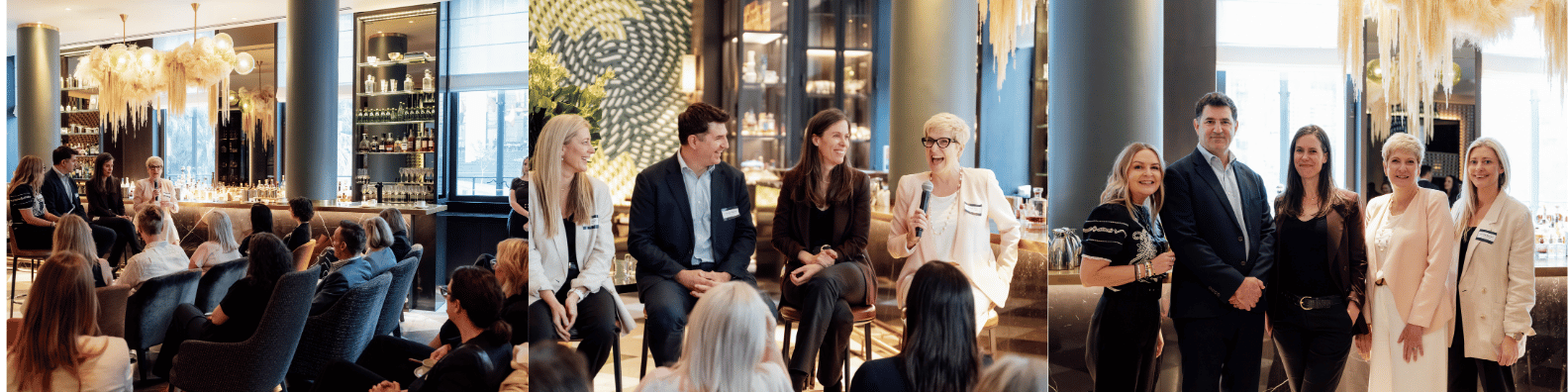
Chief People Officers and HR leaders from some of Australia's most agile organisations gathered to explore a critical question: how can people leaders accelerate impact and drive value creation in private equity-backed businesses?
The timing couldn't have been better. The audience heard that within an intensely competitive private equity landscape, the focus has shifted from buying and selling assets to extracting maximum value through operational excellence. At the heart of this transformation sits the CPO, whose role has evolved from functional head to strategic value creator.
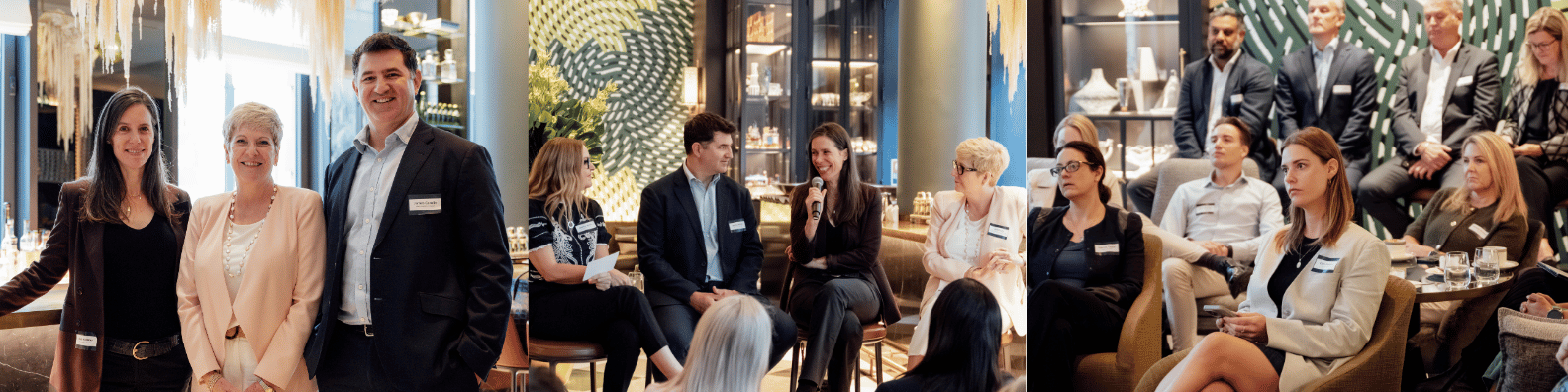
Hosted by Leanne Wells and Roxane Sexton, the event brought together three speakers with complementary perspectives on this evolution and shared backgrounds in psychology and business:
- Helen Lea, a non-executive director with experience in Chief People and Culture, and Chief Operating Officer (COO) roles spanning aged care and information technology;
- Anat Hassner, former CPO and Chief Strategy Officer at Uniting, who recently transitioned to COO at One School Global;
- and James Carolin, Operating Partner at Macquarie Asset Management, who works across an Asia-Pacific portfolio of approximately 90 companies.
The Private Equity Playbook
During a frank and open discussion, the panel agreed that to be a successful CPO, you must understand and align with investor priorities.
"Consider the reason the investment was made in the first place… where the money comes from… and what you're trying to do with it. You want to return value to the investor,” James observed.
Within private equity specifically, Helen added that “the nature of the investment matters”. “Is this a short hold or are we here for the longer term? That gives you a sense of how long you have to play and how fast you must turn the business around.” Using a simple metaphor of property renovation, she explained: “Think of a private equity hold like buying a new house. You look for something in the right sector with good bones and the opportunity to add value. You make those changes, optimise them, and when it’s time to sell, you maximise that return.”
Understanding the playbook is essential, but the real test comes when new ownership takes the keys.
The Critical First 100 Days
For an existing team, James said the moment of acquisition “can feel as if the investors arrive with a steamroller”.
“By the time we arrive at the door with the keys, we’ve looked at the hood, looked near the hood, walked around the hood, but we haven’t been under the hood. “We’ve made assumptions, we’ve been to the investment committee and defended the investment thesis. We’ve been panel beaten into shape about what we’re going to do with this asset.”
To navigate this intense transition period, Helen said you need “the ability to take (the investors) under the hood and give them the context but not drown them in detail”.
Moving forward, the panel acknowledged the CPO’s critical role in identifying core capabilities, likely impediments to progress, and human resources gaps within the existing team that must be addressed to deliver on the strategy.
“There’s an outsized amount of value in getting that right,” James observed. “As a CPO, you have influence at the board level, in the management team, and across the entire workforce.”
Courage of Conviction
Upon acquisition, Helen advised CPOs that “one of the things you can do to build your credibility very early is to have the courage to be really honest.”
“The best CPOs are those who know how to stand their ground. You understand when there is a moment where you need to be courageous. Trust rests on your ability to be very straight about what’s happening and to hold a different position at times.”
And this includes having honest conversations with team members who may not be suitable for the task at hand, because anyone who does not want to be on board for the entire journey should move now, “rather than two years into a hold where they've very often got a lot of money invested, and it's tough to extricate them.”
Regardless of whether you’re working in a PE-backed organisation or not, Anat said, moving into the role of CPO is no time to tread carefully and avoid risks. When appointed to the role of CPO at Uniting, she tackled existing issues head-on while simultaneously creating a vision for transformation.
“I looked at what was going to really mess up if I didn’t lean into it with urgency. And I looked at how I could demonstrate a vision and a future that takes the organisation into a better place.”
From CPO to Enterprise Leader
Perhaps the most empowering theme was the evolution of CPO from functional leader to enterprise thinker, with Helen articulating what distinguishes true enterprise leaders.
“The best CPOs are those who are constantly asking the question, what does the organisation need now? What does the organisation need next? This is not led from within a functional domain. You are a business leader first, and you happen to bring a functional toolkit.”
With knowledge of everybody’s KPIs, she said, “You can drive the alignment of the organisation. You are the one whipping the organisational performance in the right direction.”
And with such capacity come opportunities to further your own career, as Anat demonstrated when discussing her trajectory from CPO to COO: When interviewing for a CPO role at One School Global, she learned the COO was departing and put herself forward.
When she received pushback, she asked about the problems the COO would be challenged to resolve. The list was entirely people-related: wages, regulatory compliance, organisational issues. “So, I said, if we go through this list one by one, who do you think is best placed to solve these problems? Is it your CFO or your CPO?” Anat was appointed Acting COO, and a week into her role, they removed “acting” from her title.
The conversations reinforced what many in the room already knew but perhaps needed permission to act upon: in today’s landscape, people leaders who can drive performance, manage complexity, and align human capital with value creation plans aren’t just important – they’re essential to the deal’s success… and the rewards can be exceptional.
If you are seeking to appoint a transformative Chief People Officer or senior HR leader who can align investor priorities and unlock enterprise-wide value from day one — or if you are considering your next career move — contact us for a confidential discussion.