
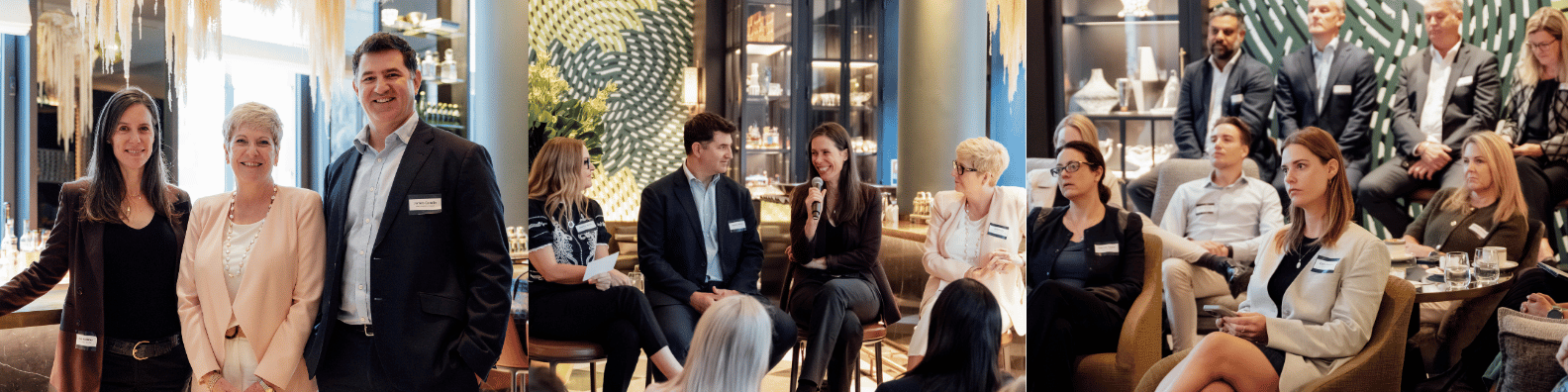
Artificial intelligence is no longer a distant strategic consideration for investors or HR leaders; it is reshaping value creation in real time. At our Human Capital in Private Equity event, hosted by Allura Partners, the conversation inevitably turned to artificial intelligence. Our expert panel made one point unmistakably clear: now is the time for people leaders to take ownership of what may be the most significant workforce transformation in generations.
Beyond Efficiency: AI as a Growth Engine
James Carolin from Macquarie Asset Management was unequivocal about how investor’s view AI’s role. “We’re not seeing AI as an efficiency tool. We’re seeing it as an accelerator, as a growth engine,” he explained. “The concept of generative AI, then agents, and then digital workers as a continuum of where this is going is real. As a group, Macquarie has leaned heavily into AI. We have digital workers, and we’re also deploying digital workers into our portfolio companies.”
This shift in perspective is critical. While cost reduction may be an outcome, the primary lens through which private equity and boards are viewing AI is as a driver of value creation and competitive advantage. “It’s a fascinating question from a workforce perspective, thinking about what the composition of my workforce will be,” James observed. “The trajectory is pretty clear, and it’s a matter of when, not if.”
The Workforce Will Never Be the Same
Anat Hassner, who transitioned from CPO of Uniting to COO of One School Global, put it even more starkly. “The number one most impactful area that AI will change is the workforce. So as people and culture leaders, we absolutely need to get our heads around what AI is doing.”
Offering a practical framework, Anat recommended Chief People Officers consider “where can we shift processes, tasks, and skills into AI, and where do we have skills that have to be maintained?”.
Context Matters: Governance and Change Management
Helen Lea, a non-executive director who sits on boards ranging from technology SaaS businesses to aged care organisations, observed that AI implementation looks dramatically different depending on organisational context.
“In the technology business, we deploy AI internally for efficiency, to get quality assurance on code, to accelerate the product roadmap,” she explained. “The question of governance is about: are we using this ethically? What tools are we using? What does this mean for data and privacy?”
However, the aged care context presents entirely different considerations. “You’re in people’s homes, dealing with physical matters. The complexity of getting it right and containing the risk is in a different place, on the scale. Context really does matter.”
The AI Savviness Advantage
Helen referenced recent research showing that AI capability is already creating performance differentiation. “There’s a paper out that shows pre-COVID, one of the major performance differentiators was a digitally savvy board and executive. What they are showing already is an AI-savvy board, and the executive is already showing a differentiated performance advantage.”
This creates both urgency and opportunity for CPOs. “The most critical contribution is building that savviness across your organisation; building the courage to adopt, to play, to experiment, creating a sandpit of experience and curiosity that you’re encouraging your employees into.”
Outlining the CPO’s unique role, she said, “You can play a really active part in the education and learning pathways, in the change management, in the development of use cases, and thinking about how work can be done differently inside the organisation.”
Education and Objective Assessment
The panel’s advice to CPOs was pragmatic. James recommended specific action: “Get yourself educated. Understand how AI might impact the workforce and understand how you can leverage it for value creation.” He also cautioned, “From a risk perspective, you have to be really clear-eyed. Don’t buy the hype. Be clear-eyed about where you can use it and where it might not help.”
For Chief People Officers, the message from the entire panel was clear: AI is not coming for the workforce – it’s already here. The question is whether people leaders will shape that transformation or simply react to it. Those who build AI savviness across their organisations, thoughtfully redesign work, and manage the change with rigour will position their organisations for sustainable competitive advantage. The time to start is now.
If you are seeking to appoint a transformative Chief People Officer or senior HR leader who can align investor priorities and unlock enterprise-wide value from day one — or if you are considering your next career move — contact us for a confidential discussion.