
This article was contributed by Leon Young, Principal Consultant - Data & AI at Allura Partners
Not many data leaders can say their career began in formal insolvency. Michael Nowland can. Working in distressed M&A in the aftermath of the Global Financial Crisis, he gained early exposure to what bad analysis actually costs and a front-row seat to the evolving profession of data analytics that would become his career.
That moment, turbocharged by the now-famous Harvard Business Review piece declaring data science the "sexiest job of the 21st century", set the course for a career spent building data, analytics, and AI capabilities across some of Australia's most complex and heavily regulated industries: finance, energy, healthcare, government, and consultancy. Across greenfield builds, scaling analytics functions and enterprise transformation, his focus has remained consistent: data only matters when it improves decisions, strengthens trust and creates measurable impact.
Today, Michael is General Manager of Data & Analytics at Lumus Imaging, building the data, analytics, and governance capability for one of Australia's largest pure-play medical imaging networks.
His philosophy is clear: data analytics is a team sport, with technology, models, and platforms being important, but the human elements around them determining whether insight becomes action. I sat down with him to explore how data and AI — applied well and across an entire organisation — can truly propel growth.
Q. In organisations where the value of data isn’t immediately obvious, what are the first questions leaders should ask to uncover meaningful opportunities?
I’d start with the business model, not the data. The most useful questions don’t begin with “what data do we have?” – they begin with “what value are we trying to create, and what are the drivers of that?” Then you work backwards to what information would meaningfully influence those drivers.
You can think of it like hanging a painting – you start by wanting the painting on the wall, and it’s that goal that tells you that you need a nail, a hammer, and a wall strong enough to carry the weight. Data analysis is the how here, not the end goal in itself. Without that clarity, you risk doing a lot of interesting analysis that isn’t actually aligned with where you want to go or what you can act upon.
Q. Many businesses want to become data-driven but struggle to know where to start. What are some practical early wins that build momentum without over-engineering the approach?
Start with something practical, visible and close to a real business decision. The goal is not to prove that data is clever; it is to prove it’s useful.
Data is a team sport – it always has been. That means the work is never just about the analysis; it’s about building the feedback cycles with your stakeholders that validate whether what you’re producing is accurate, useful, and moves people towards their goals.
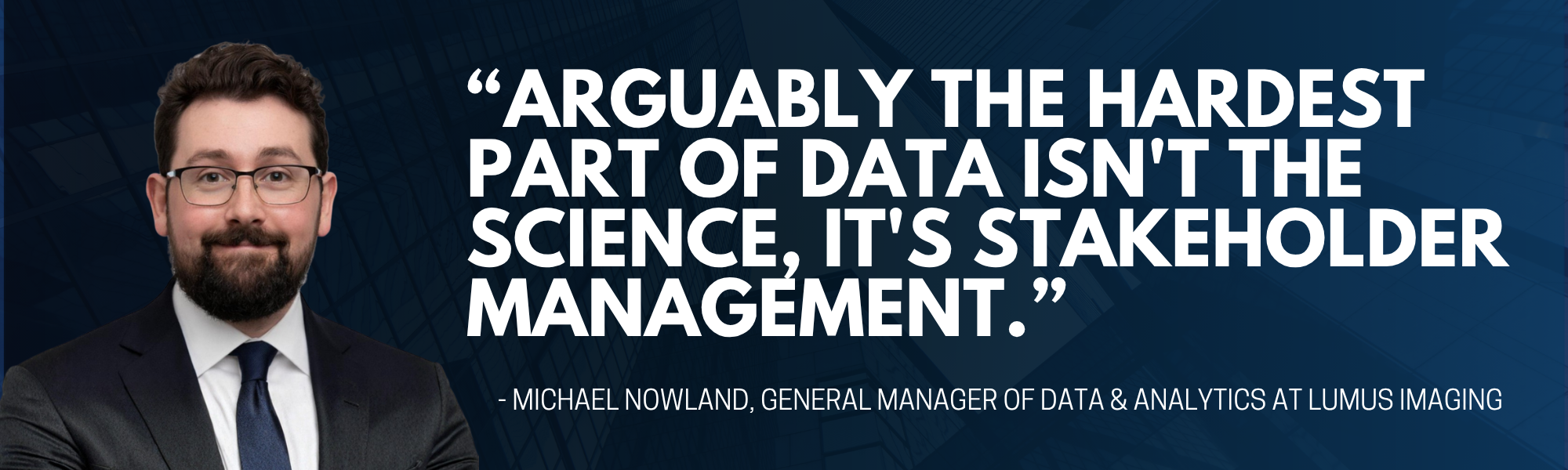
Early wins should create confidence. Once people see that the data function can solve real problems, communicate clearly and deliver without over-engineering, you earn the licence to take on larger, more complex and higher-risk initiatives. Arguably, the hardest part of data isn’t the science – it’s stakeholder management. If you neglect the human element, even the most technically brilliant work will fall flat.
Q. What separates organisations that successfully embed data into decision-making from those that treat it as just another technology initiative?
It comes back to people, almost every time. Someone in the data and analytics function – usually the leader of it – needs to act as a translator: maintaining a clear channel between the boardroom’s strategic vision and the team responsible for building and executing on that agenda. Without that channel and the alignment it brings, progress can stall.
Translation alone, however, is not enough. The business also has to be engaged. Data teams create the most value when they are embedded in the operating rhythm of the business, rather than sitting outside it. Trust, shared ownership, and active feedback are usually good indicators that data has moved from being a reporting function to becoming part of how the organisation makes decisions.
Q. With growing demand for AI and data capability, what should organisations think about when it comes to attracting and retaining the right leaders?
The conversation around AI changes so quickly that trying to specify an exact profile risks being out of date almost immediately. What matters more is clarity of vision: the ability to hold a clear strategic destination while adapting the path as the technology changes.
A commercial aircraft is a useful analogy. It almost never points directly at its destination because it’s constantly adapting to weather and air traffic competing for space. But it almost always arrives safely and on time because the destination is clearly known and navigated to. Leaders who can hold that vision and provide that fixed point of clarity – while remaining genuinely adaptive – are the ones who will pull ahead.
Alongside that focus on the end goal, a considered governance lens and ethical mindset are also essential. The probabilistic nature of generative AI presents new possibilities that require more creative thinking. And by nature, that makes skills in governance more important. Executives need to think through where variability in outputs is a feature versus a material risk.
Q. What are the most common mistakes organisations make when trying to accelerate their data maturity too quickly?
Over-investing in technology and under-investing in behaviour change. The proliferation of AI Copilots across almost every software product is a useful example – just because a capability exists, doesn’t mean it will generate value for your business. If it is not connected to a real workflow, a real decision, or a real performance lever, it quickly becomes another underused feature.
The organisations that accelerate well tend to be those that identify their highest-value business levers first, then determine how data and AI can meaningfully contribute. It is about creating repeatable ways to turn information into better outcomes that matter.
Q. What are you noticing about the way businesses are structuring their data and AI workforces today?
We’re at an interesting inflection point. When I started my career, the dominant model was the “superhero” data scientist – a highly empowered individual, often with a PhD, who could span engineering, analysis, statistical modelling, and executive communication. The challenge was that these were unicorn personas. Over time, the work separated to reflect specialisations that we now associate with a full-stack data team, with diverse, adjacent skillsets working together across the value chain.
It feels currently like AI is pulling us back towards the empowered individual in some respects – one person with the right tools and a meaningful token budget can have an outsized impact. But we don’t yet have full clarity on the risks, the repeatability, or how that model will evolve, which makes me suspect we will see this cycle of role evolution repeat.
My expectation is that we’ll see a realignment – not necessarily a return to the solo superhero, but more empowered individuals operating within considered, well-constructed, cross-functional teams.
Q. If you were to advise your younger self on how to approach a career in AI and data today, what would that advice be?
It’d be something to the effect of experiment, explore, and “do”. Even if it’s before you feel ready, have a crack, explore, challenge yourself, and give multiple avenues a real try. The people who progress fastest in data and AI are often not the people who waited until they had the perfect plan. They are the people who developed judgment through action. They built a track record of useful delivery, learned how to work with stakeholders, and kept moving towards problems that mattered. Failure is part of learning, but the aim is not to fail for its own sake. The aim is to shorten the distance between trying, learning and improving. In a field moving this quickly, that willingness to act is a real advantage.
.png?width=1275&height=149&name=Email%20Signature%20Technology%20%26%20Digital%20Banner%20(1).png)